MINDCAF AND IOM EXPLORE NEW AVENUES FOR COOPERATION
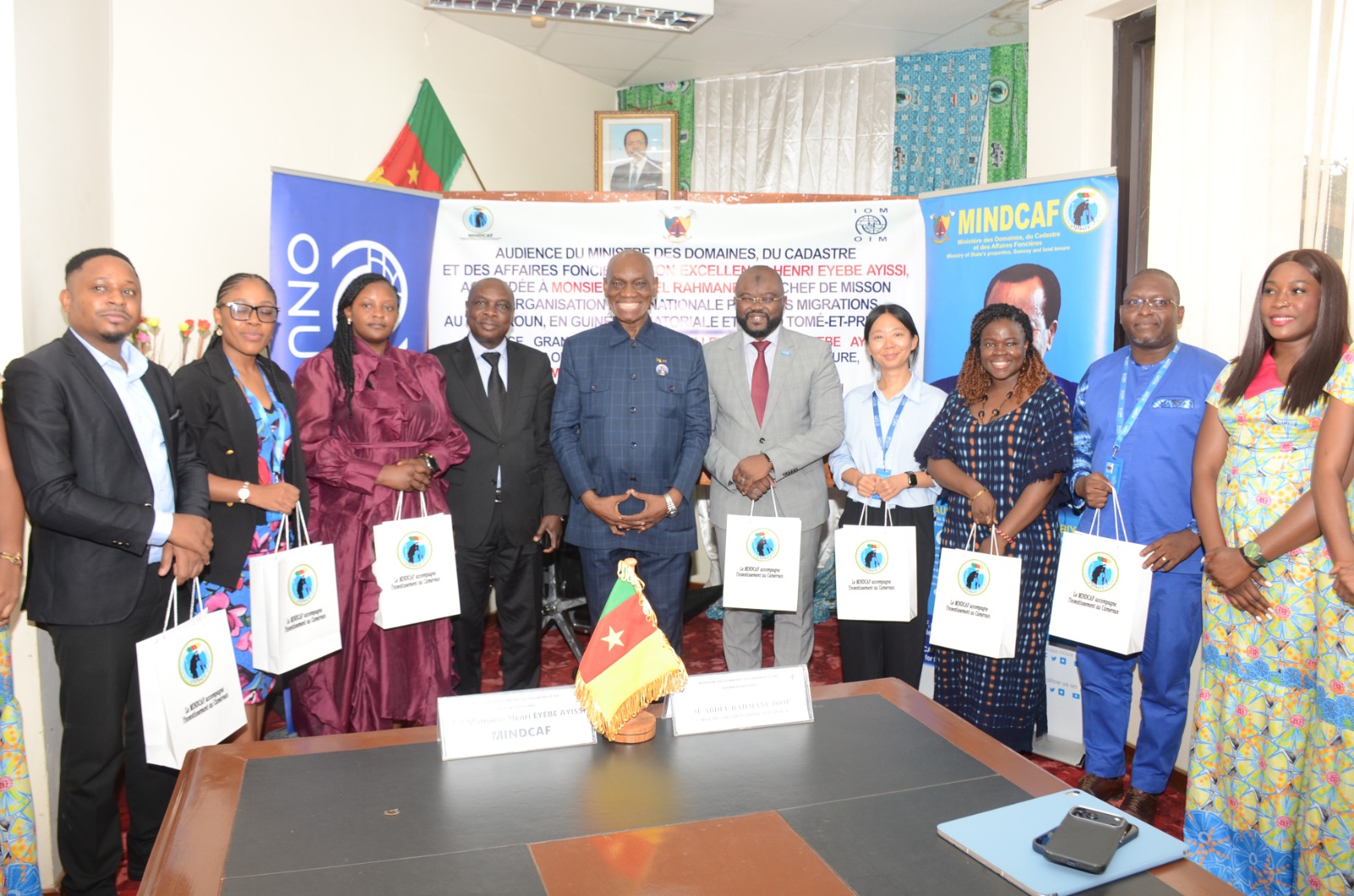
The issue of access to land and its interplay with migration dynamics were at the heart of a meeting between the Minister of State Property, Surveys and Land Tenure, His Excellency Henri Eyebe Ayissi, and a delegation from the International Organisation for Migration (IOM) on Monday, 5 October 2026 in Yaounde.
Cooperation between Cameroon and the International Organisation for Migration (IOM) could gain new momentum through better mainstreaming of land-related issues into migration policies. It was against this backdrop that the Minister of State Property, Surveys and Land Tenure, H.E. Henri Eyebe Ayissi, received an IOM delegation.
The main aim of this meeting was to examine ways of strengthening cooperation between the two institutions and identify areas for collaboration on land issues related to migration dynamics.
During the discussions, the IOM representative praised the quality of cooperation between the Republic of Cameroon and the International Organisation for Migration. He particularly highlighted the importance of Cameroon’s commitment to the Global Compact for Safe, Orderly and Regular Migration, which, in his view, provides a favourable framework for the development of new initiatives in this area.
The issue of land tenure is, in fact, an important dimension of population movements. Pressure on land resources, as well as difficulties in accessing land, can influence decisions to migrate, but also the conditions for the return and reintegration of migrants. In this context, land tenure security and sustainable land management are relevant issues for both land policies and migration policies.
For the IOM, it was therefore necessary to engage in dialogue with the ministry responsible for land-related issues in order to identify areas in which deeper cooperation could be developed. This specifically involves considering an institutional framework to structure and formalise the various areas of collaboration between the two parties.
This initiative comes at a time when several strategic documents and public policies are being drawn up in Cameroon. The IOM therefore considers it appropriate to strengthen the links between land policies and migration policies, so that both dimensions can be mainstreamed in a complementary manner into national strategies.
Beyond the issue of access to land alone, these discussions thus open up a broader brainstorming on the nexus between land tenure, population mobility, and the return and reintegration of migrants. This integrated approach could help to better anticipate pressures on land and identify responses tailored to the realities faced by populations.
In this light, the meeting between MINDCAF and IOM marks a step forward in exploring new avenues for collaboration. It also reflects the commitment of both parties to pool their expertise in order to contribute to the development of coherent strategic frameworks, taking into account both land management imperatives and contemporary migration-related stakes.
Through this move, land is thus seen as an integral component of development and human mobility policies, calling for greater consultation between the relevant institutions.
Derlin Afana